


 1 (760) 224-9616
Last Updated: November 22, 2026
Quick Summary
Choose adjustable dumbbells for a small home gym by measuring your tray footprint, height, and handle swing clearance before buying, then pick a cage-free dial or pin set that fits under a bench. Buy a weight range that covers your hardest lift, not your easiest, because a set that tops out too light becomes furniture within a year.
- Fixed dumbbells from 2kg to 24kg in 2kg steps means twelve pairs; one adjustable pair does the same job from a single tray.
- Tape the tray rectangle on the floor and allow roughly one handle length of clear space per side.
- Dial systems give the smallest stored tray and adjust one-handed, but have more internal parts and are rarely repairable at home.
- Selector pin sets are usually the most repairable design, though adjustment is a two-handed job on most pin sets.
- Confirm an expansion kit exists for the model you buy before you commit, because not every set supports one.
Table of Contents
- Why Adjustable Dumbbells Suit Small Home Gyms
- Adjustable Dumbbells vs Fixed Dumbbells: Space and Cost Trade-Offs
- How to Measure Your Space Before You Buy
- The Most Compact Adjustable Dumbbells for Tight Spaces
- Choosing the Right Adjustable Dumbbell Weight Range
- Best Budget Adjustable Dumbbells: What to Expect
- Noise, Floor Protection, and Shared-Wall Considerations
- Shop Adjustable Dumbbells at onlinegotmine.com
- Frequently Asked Questions
Why Adjustable Dumbbells Suit Small Home Gyms
Adjustable dumbbells are one pair of handles that replace a full rack of fixed weights, making them the most space-efficient strength tool for a small home gym.
Fixed dumbbells from 2kg to 24kg in 2kg steps means twelve pairs and a footprint that swallows a corner of a room.
The catch: "adjustable" covers wildly different products, and the differences matter most in small rooms.
Three things decide whether a set works in a tight space:
- Footprint. The tray or cradle takes up floor area even when the weights are racked.
- Adjustment speed. Slow changes break your workout rhythm and encourage you to skip sets.
- Weight ceiling. A set that maxes out too light becomes furniture within a year.
Adjustable Dumbbells vs Fixed Dumbbells: Space and Cost Trade-Offs
Fixed dumbbells win on speed and feel. Adjustable dumbbells win on space and total cost of ownership, and for many small home gyms that trade is worth taking.
Here is how the two compare in practice:
| Factor | Adjustable Dumbbells | Fixed Dumbbells |
|---|---|---|
| Floor space | One tray, roughly the size of a shoebox pair | A rack or long row of pairs |
| Cost for a full range | One purchase covers many weights | You buy each pair separately |
| Weight change speed | Seconds to a minute, depending on mechanism | Instant, grab and go |
| Durability risk | Moving parts and locking mechanisms wear | Almost nothing to break |
| Best for | Small rooms, limited budgets, varied training | Dedicated gyms, heavy lifting, fast circuits |
The cost argument is where adjustable sets can win.
The honest limitation: adjustable dumbbells feel different. The handle is often longer, the balance shifts as plates move, and you cannot drop them.
How to Measure Your Space Before You Buy
Most guides tell you to measure your room but not what numbers to write down. Here is a measurement sheet you can complete in ten minutes.
Measure the floor area you can dedicate, not the area you hope to use. Most buyers skip this and end up with a tray that blocks a doorway or a stand that will not fit under a shelf.
The five numbers that decide whether a set fits
Write these down in order. Every product page lists at least some of them; if a listing omits one, treat that as a warning sign.
- Tray footprint (length x width). The stored size of the whole set, not one dumbbell. A tray is wider than the dumbbell because it cradles every plate. Tape the rectangle on the floor.
- Tray height. The stored height of the cradled dumbbells, including the handle. This decides whether the set slides under a bench, shelf, or bed frame.
- Handle swing clearance. The open space needed on each side of the tray to lift a dumbbell out and set it back. Allow roughly one handle length of clear space per side; cage-style trays need more because the outer frame catches your knuckles.
- Training-zone depth and width. The area your arms travel through during a press, row, or lateral raise. Tape this out at full extension, not at rest.
- Walking gap. The clear path past the tray. If you cannot step past it without turning sideways, the set is too big for that spot.
A worked example for a small room
Take a spare-bedroom corner roughly 2 m x 1.5 m. Tape a training zone of about 1.8 m x 1.2 m so your arms clear the walls during a press.
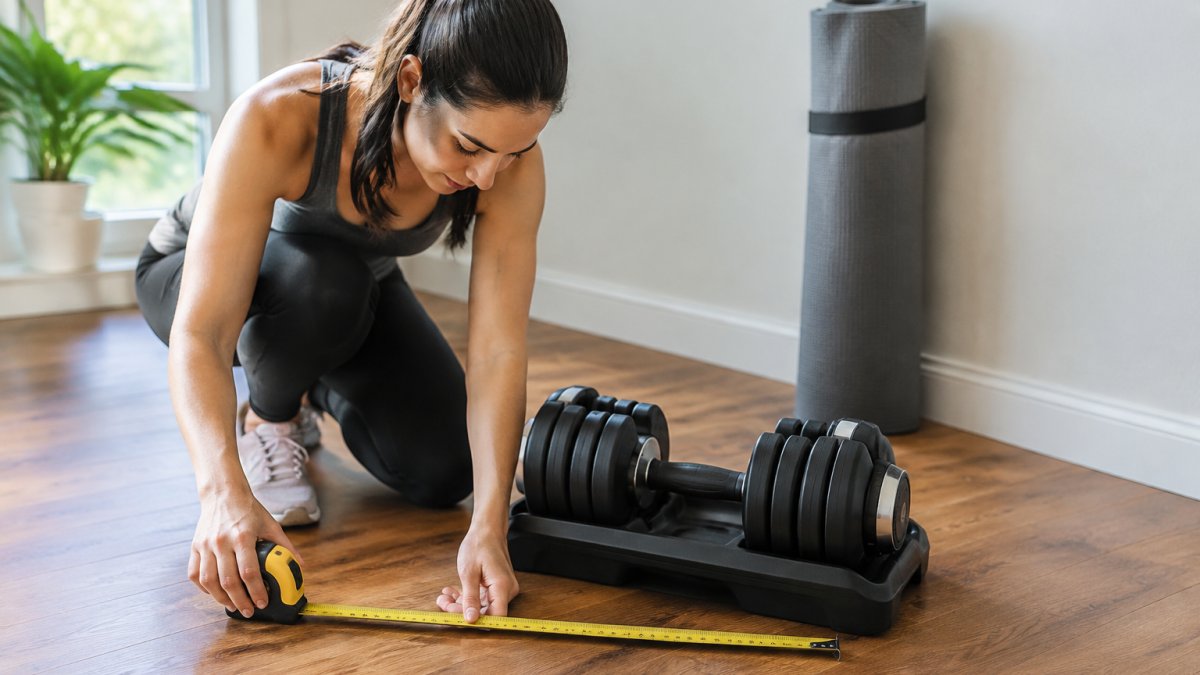
Footprint, Storage Trays, and Clearance
Storage trays are the part buyers underestimate. A tray needs a flat, level surface.
Clearance matters as much as footprint. You need open space on each side of the tray to lift the dumbbell out cleanly.
Watch out: a tray on an uneven floor can tip when you re-rack a heavy dumbbell. Check it sits flat before loading, and shim it if it rocks.
Storage planning beyond the floor
Small rooms usually have more wall and vertical space than floor space. Two options are worth measuring before you buy:
- Under-bench storage. Measure the clearance under your bench. If the tray height fits, the set disappears between sessions.
- Vertical stands. Some sets offer a stand that holds the trays upright or stacked. Measure its footprint and height against the wall, and check it does not block a door swing or a radiator.
If you are weighing up whether a cheaper set is a false economy, our guide to budget sports gear picks covers what to expect from lower-cost equipment.
The Most Compact Adjustable Dumbbells for Tight Spaces
The most compact adjustable dumbbells for tight spaces are the ones with a cage-free design, a single low tray, and a dial or selector pin rather than loose plates you load by hand. But "compact" is not one number, it is a set of trade-offs between stored footprint, adjustment speed, noise, and repairability.
Dial systems
A dial rotates to set the weight, and the plates nest inside a captive stack. This gives the smallest stored tray of the common designs because plates do not need to spread out to be selected.
The trade-offs: dial mechanisms have more internal parts, so they are the design most likely to need a replacement part, and they generally cannot be repaired at home.
Selector pin systems
A pin slides into a hole to choose the weight. The mechanism is simple, visible, and easy to understand, and because there is less internal gearing it is often the most repairable design.
Adjustment is a two-handed job on most pin sets: one hand holds the handle while the other pulls the pin. That is slower than a dial and noisier, because plates shift as the pin engages.
Plate-loaded sets
Loose plates and a locking collar are the cheapest design and the most compact when disassembled, because plates can stack in a corner. They are also the slowest to change and the messiest in a small room: plates roll, collars get lost, and you need somewhere to put the plates you are not using.
For a tight space, plate-loaded sets only make sense if storage is the binding constraint and you will trade workout rhythm for it.
What "compact" should mean on a product page
When you compare listings, look for these specifics rather than the word "compact":
- Stated tray dimensions in length, width, and height. If the listing gives only the dumbbell length, ask for the tray size.
- Cage-free or caged tray. Cage-free trays need less swing clearance and are kinder to knuckles.
- Weight range and increments. A set can be compact because its ceiling is low. Check the top weight before you fall for the footprint.
Watch out: some compact sets are compact only because their maximum weight is low. A set that tops out too light becomes furniture within a year, no matter how neatly it stores.
Matching the design to the room
A simple rule: if floor space is the tightest constraint, favour a dial set with a low, cage-free tray that fits under a bench. If repairability and simplicity matter more than the last centimetre, favour a pin set. If budget is binding and you have a cupboard for loose plates, plate-loaded is the fallback, but measure the cupboard first.
Choosing the Right Adjustable Dumbbell Weight Range
Choose a weight range that covers your hardest exercise, not your easiest.
Work backwards from your main lifts:
- Overhead press is usually the lightest lift, so it sets your floor.
- Goblet squat and row sit in the middle.
- Bench press and Romanian deadlift set your ceiling.
A common mistake is buying a set that tops out at a comfortable weight for squats. Within months, the squat outgrows it and the set stops being useful.
Expansion kits let you add plates later, which is a sensible hedge if budget is tight. Confirm the kit exists for the model you buy before you commit, because not every set supports one.
Best Budget Adjustable Dumbbells: What to Expect
Budget adjustable dumbbells typically trade finish and adjustment speed for a lower price, and for a small home gym that trade is often acceptable.
What you should still insist on, even at the lower end:
- A locking mechanism that holds plates tight with no rattle
- A handle with enough knurling to grip when your hands are sweaty
- A tray that sits flat and does not tip when you rack the weight
What you can give up: fancy finishes, quick-change dials, and long warranties. What you should not give up: safety.
For a broader look at where cheap gear is worth it and where it is not, our breakdown of budget sports gear picks is a useful sanity check before you buy.
Noise, Floor Protection, and Shared-Wall Considerations
Noise and floor damage are the two complaints small-gym owners report most, and both are manageable with a little planning before the weights arrive.
Weight plates set down on a hard floor are loud. In a flat or a terraced house, that noise travels through the structure, not just the air. Three fixes work:
- Rubber mats. A dense rubber tile under the training zone absorbs impact and protects the floor.
- Controlled lowering. Set the dumbbells down rather than dropping them. Adjustable sets are not built to be dropped.
- Distance from shared walls. Keep the training zone off the wall you share with a neighbour, and train earlier in the evening rather than late at night.
Floor protection matters for the weights too. A dropped plate can crack a tile or dent a wooden floor, and a cracked plate is a safety problem.
The other shared-wall issue is vibration. Heavy sets on a suspended floor send a thump through the building.
Shop Adjustable Dumbbells at onlinegotmine.com
You now have the criteria that matter: footprint, adjustment mechanism, weight range, and noise control.
At onlinegotmine.com, we offer a broad catalog across home and fitness categories, so you can browse adjustable dumbbells alongside other home essentials in one place.
Start with your measurements, pick your weight ceiling, then shop with confidence at onlinegotmine.com and build a home gym that fits the room you actually have.
Frequently Asked Questions
Are adjustable dumbbells worth it for a small home gym?
For most small home gyms, yes. A single pair of adjustable dumbbells can replace a full rack of fixed weights, which frees up floor space. You get a wide weight range in one footprint. The trade-off is that some models are longer or bulkier than fixed dumbbells at lighter weights, so check the dimensions against your available space before buying.
How much space do adjustable dumbbells need?
Adjustable dumbbell sets need a storage tray footprint plus clearance to lift them out of the tray. Measure your corner or rack area first, then compare it to the listed tray dimensions of the sets you are considering.
What weight range should I choose for adjustable dumbbells?
Match the adjustable dumbbell weight range to your current strength and goals. Beginners often do well with a lighter range, while intermediate lifters who plan heavy pressing or rowing may want a set that goes heavier. If you are unsure, pick a set with a wider range so you do not outgrow it within a few months.
Are adjustable dumbbells suitable for beginners?
Yes. Many adjustable dumbbells are beginner-friendly, with clear weight increments and simple dial or selector pin systems. Start with lighter weights and focus on form before adding load. The main learning curve is getting comfortable with the adjustment mechanism and checking that plates are locked before each set. A set with small weight increments makes it easier to progress gradually without big jumps.


